
History · Sites
Why Templar Enthusiasts Should Visit Castelo de Vide
9 min read
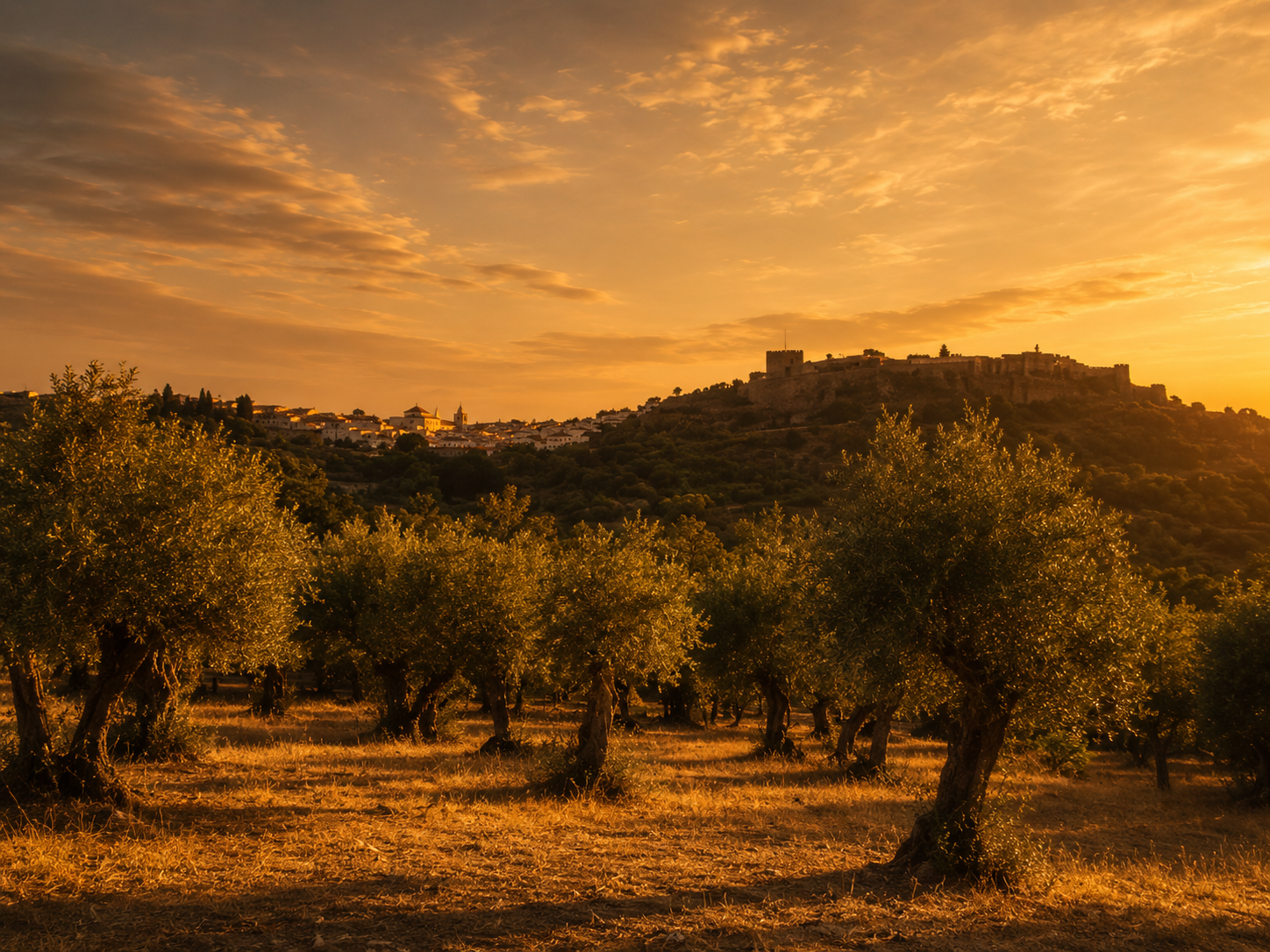
The wind moves differently here than in Tomar.
In the Convento de Cristo, the wind moves through cloisters built for contemplation — vaulted, enclosed, ceremonial. In Castelo de Vide, it moves across open granite, through gaps in walls that were built, rebuilt, besieged, and rebuilt again, over five centuries, by people whose only question was whether the next attack would come from the east or the south.
Tomar is where the Templars' memory was preserved. Castelo de Vide and its surrounding territory are where their successors actually worked the frontier.
A hill that was always going to be defended
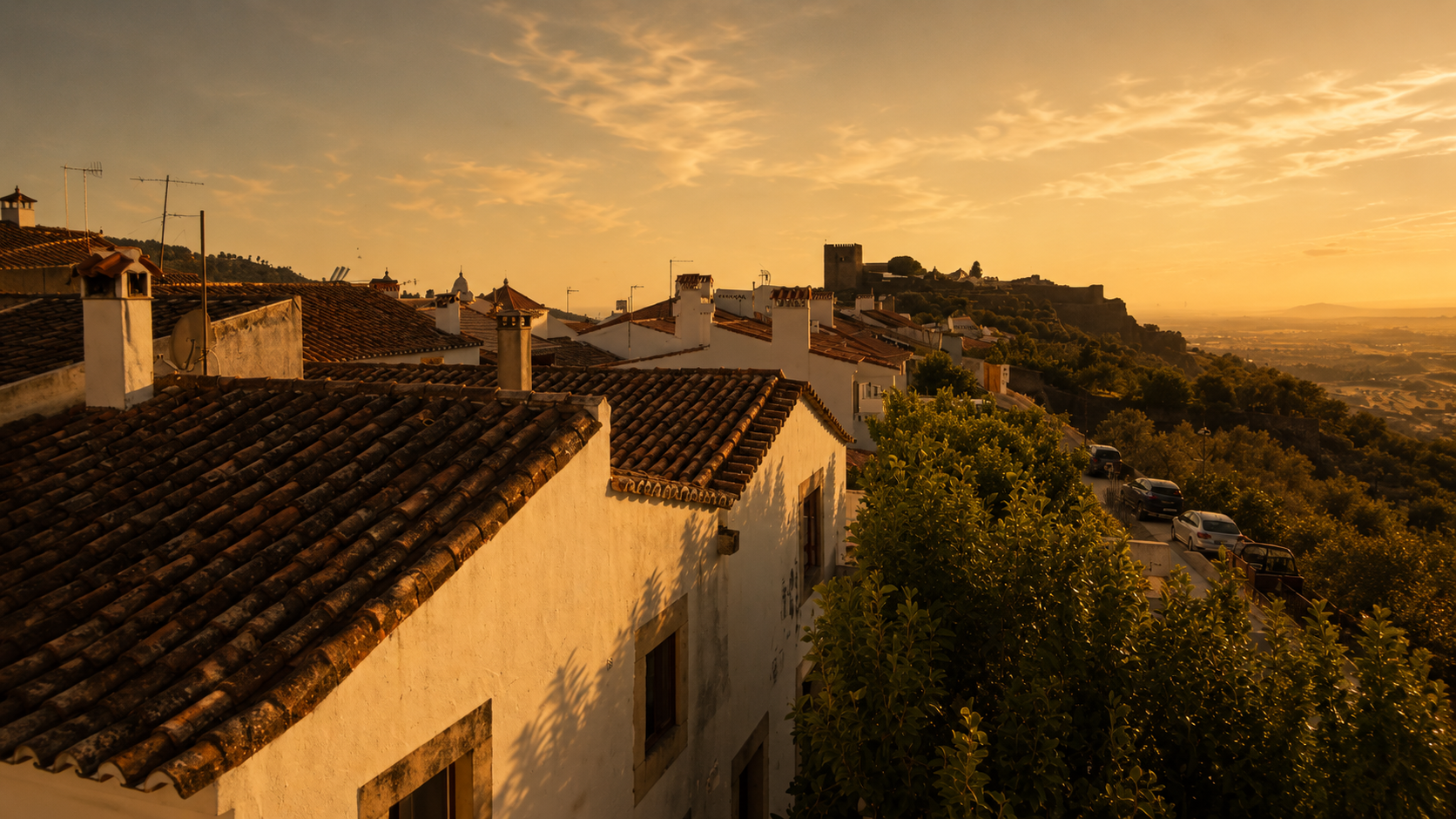
Long before any Order arrived, the hill of Castelo de Vide had already decided its own fate. It sits at roughly 600 metres of altitude, above a stream the Christians would later name São João, which runs some hundred metres below. The site offered what military geography calls a ponto-chave — a key point: natural defensibility combined with fertile surrounding land and reliable water. A Roman villa is thought to have existed on the slope descending from the hilltop, and Arab sources from the tenth century already record a husun — a small fortified post — on the site, probably a modest, roughly rectangular structure.
That fort was taken from Muslim control sometime in the twelfth century, during the reign of Afonso Henriques — Portugal's first king, pushing the frontier of his young kingdom southward through the scattered taifa territories of the Alentejo.
What happened immediately afterward is poorly documented. The settlement, then called simply Vide, may have received an early charter around 1180. It is certain that it was included within the 1226 charter granted to Marvão under King Sancho II — meaning Vide's fortunes were, for a time, administratively bound to its more famous neighbour to the north.
A war between brothers
In 1273, King Afonso III donated Vide to his son, the Infante D. Afonso — who already held Portalegre, Arronches, and Marvão. This was not yet the Order of Christ, and not yet, strictly, the Templars either: this was a royal grant to a prince, one chapter in the long process by which the Portuguese crown distributed frontier territory among its own house.
What followed was a genuine family crisis. In 1280 — the first year of the reign of King Dinis — the Infante D. Afonso decided to wall the town and raise a tower without royal authorisation, a direct affront to the crown's exclusive right to fortify (the Ius Crenelandi). Dinis was furious. He laid siege to the town between April and May of that same year.
The conflict did not resolve quickly. In 1282, through an agreement brokered by Pedro III of Aragon, the Infante committed — in the explicit wording of the surviving document — to "derribar... tudo aquilo que de novo foi feito na Torre de Vide e no muro desse logar": to tear down everything newly built on the tower and the town wall. Tensions between the two brothers continued to flare until the Infante's death, after which Vide returned definitively to the Crown.
It was around this point — as Gothic military architecture was beginning to take hold across Portugal — that a serious reform of Castelo de Vide's defensive system began.
King Dinis builds for the long term
After the Treaty of Alcañices with Castile in 1297 fixed the border, Dinis undertook a systematic programme of building and rebuilding fortifications along the new frontier. Castelo de Vide received a new castle and a town wall, roughly rectangular in plan, which became not merely a defensive structure but the generative core around which the town itself grew. For the following five centuries, the logic of Castelo de Vide's urban expansion was directly or indirectly subordinate to military requirements.
The castle occupied the highest point of the hill — though its original entrance, in this period, opened toward the interior of the town rather than toward today's main courtyard, following the standard medieval security principle that any direct exterior access point was a vulnerability, typically reserved for narrow sally-ports known as Porta da Traição (Traitor's Gate) or Porta das Sortidas (Sortie Gate).
The structure that survives today is, in the words of the military historian who has studied it most closely, something of an enigma. It does not correspond cleanly to any standard Portuguese castle model of the period. Towers that once flanked the walls have vanished; the system of access does not follow expected security logic; the depth of defence is incomplete. What we are looking at, in other words, is a defensive structure that has been absorbed and altered by a more evolved system layered on top of it over centuries — not a single coherent medieval design frozen in time.
The Order of Christ — a brief, undocumented decade
Here is where the historical record forces real intellectual honesty.
In 1372 or 1373 — the surviving documentation places it in slightly different years — King Fernando I donated the town of Castelo de Vide and its surrounding territory to the Order of Christ, the direct institutional successor to the dissolved Knights Templar. This act connects Castelo de Vide to the broader story of Templar continuity in Portugal: the Order of Christ, created in 1319 specifically to inherit the suppressed Templar institution, administered former Templar territory across the Alto Alentejo, including the commanderies at Nisa and Alpalhão to the north.
But the honest historical record contains a humbling detail: the Order of Christ's knights remained in possession of Castelo de Vide for less than a decade. No physical evidence — no construction, no surviving record of military investment — has been identified from this brief tenure. The castle took part in the dynastic crisis of 1383–1385, declaring for the Master of Avis (the future King João I) against Castilian claims to the throne, but whatever the Order of Christ contributed to the town during its short administration left no trace that has been recovered.
This is worth saying plainly, because it is more honest than the alternative. It would be easy to claim a grander Templar legacy for Castelo de Vide's stonework than the evidence supports. The castle that stands today is overwhelmingly the work of the Portuguese crown — Dinis in the thirteenth and fourteenth centuries, his successors through the following two — not of the Templars or their Order of Christ successors directly. What connects Castelo de Vide to the Templar story is not that the Order built these walls, but that it administered this frontier territory, briefly, as part of the same institutional network that held Nisa and Alpalhão — and that the wider territory of the Açafa, granted to the Templars in 1199, lies immediately to this town's north and east.
The Templar connection here is geographic and institutional, not architectural. That distinction matters, and a serious visitor should know it.
A castle built to watch, not just to wall
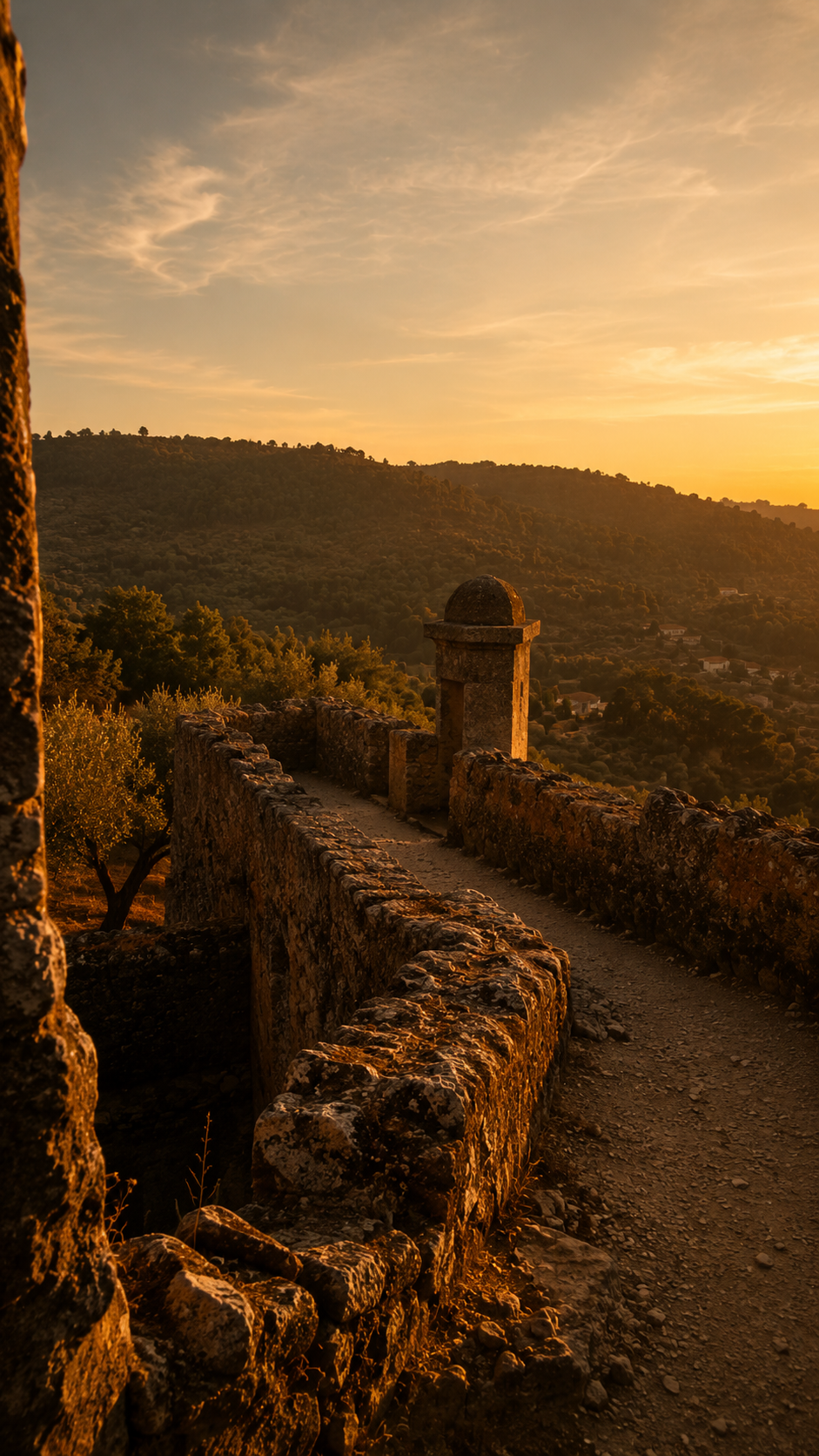
What the surviving structure does show, with real clarity, is how thinking about defence evolved between the tenth and fifteenth centuries.
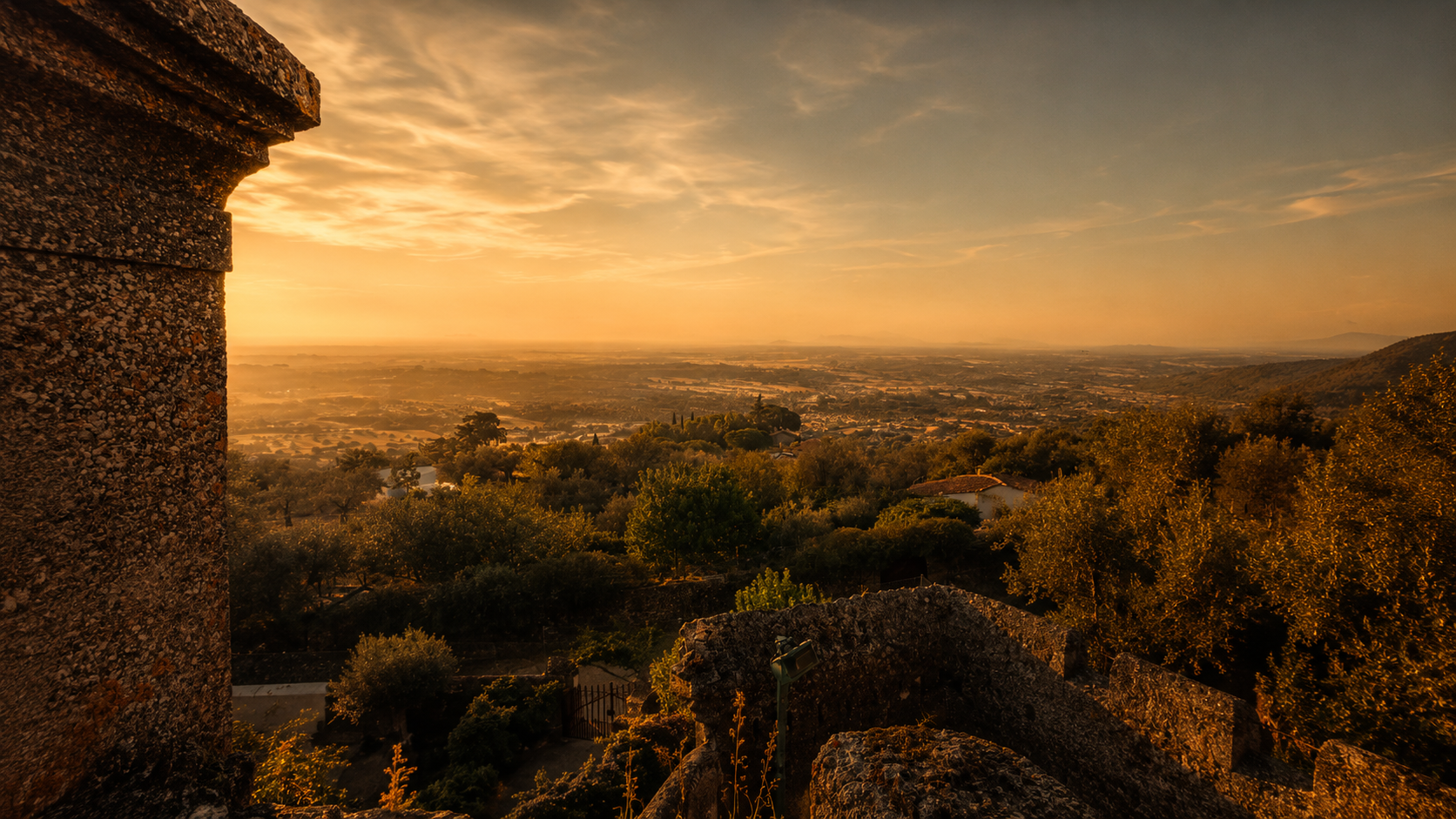
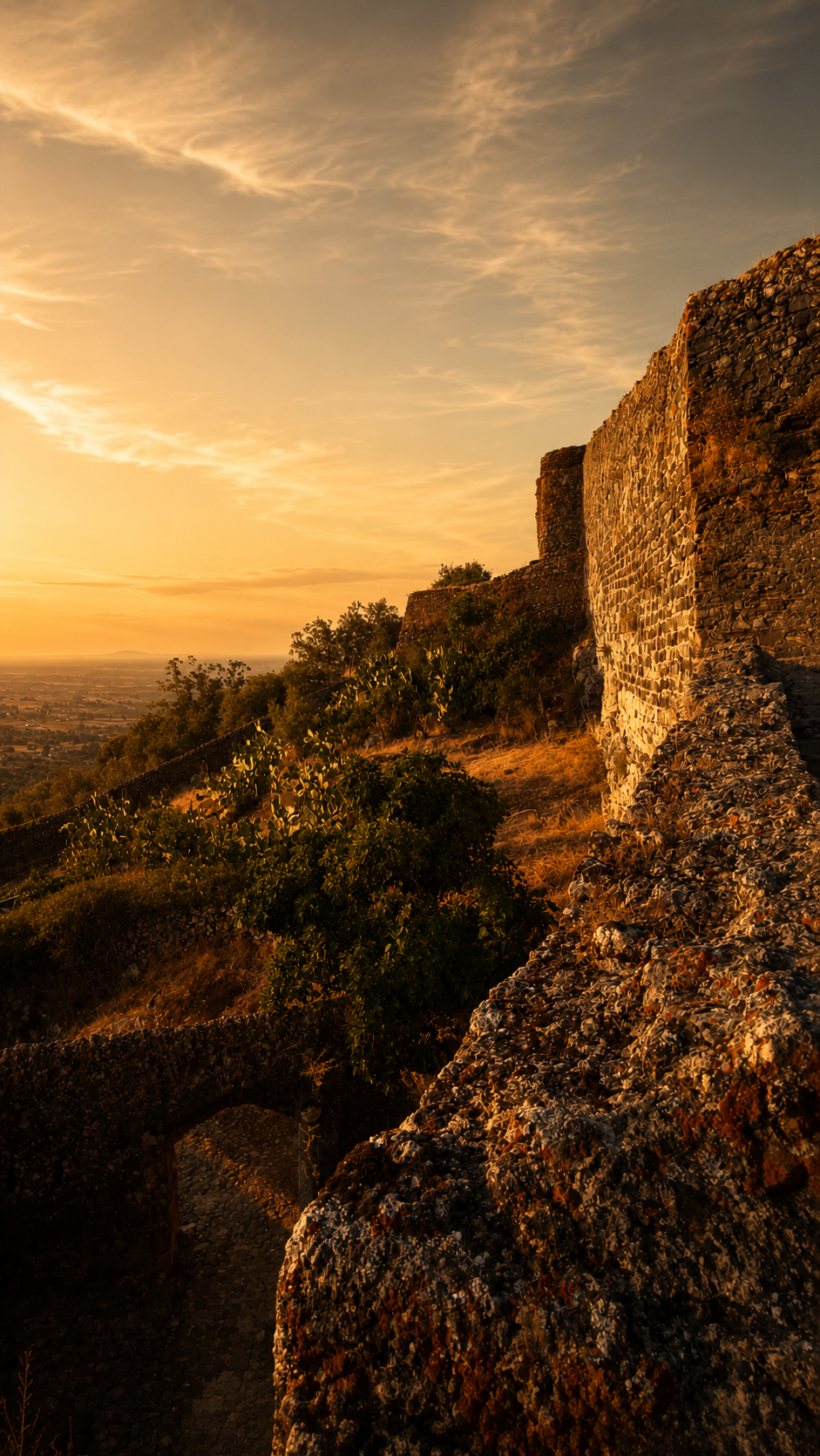
The castle's position offered what military analysis calls near-absolute command of the surrounding slopes — the ability to observe, and fire upon, anyone approaching from a considerable distance. Walls of this period typically stood three to six braças high (roughly 6.6 to 13.2 metres) with a thickness exceeding one braça — over two metres. Where the terrain already fell away steeply, as it does here, a moat became unnecessary; the garrison's advantage was built into the landscape itself.
Gothic-era refinements added projecting towers that reduced blind spots along the walls, raised firing platforms, and eventually a barbacã — an outer defensive perimeter — to increase the depth of defence. The keep that survives, the Torre de Menagem, shows clear signs of having been altered repeatedly over the centuries, including a twentieth-century reconstruction of its upper section by Portugal's national monuments authority after it had fallen into ruin. Its door, set more than two braças above ground level for security, opens onto a chamber roofed in ribbed Gothic vaulting — a detail confirming that whatever its early origins, the tower as it stands belongs to a later, more sophisticated phase of construction.
By 1509, when the royal surveyor Duarte d'Armas sketched Castelo de Vide for his Livro das Fortalezas, the castle's defences included this barbican and two couraças — covered passages descending the southern and eastern slopes to protect access to water sources outside the main walls. Water scarcity inside the fortified perimeter was, by this period, the site's single most critical vulnerability — more pressing, in practical terms, than the threat of artillery, which Portuguese fortification had not yet fully reckoned with.
The siege of June 1704
The medieval and Gothic-era defences that had served Castelo de Vide for four centuries met their decisive test during the War of the Spanish Succession.
On 30 April 1704, Philip V — the Bourbon claimant to the Spanish throne — declared war on Portugal. He personally led a Spanish army of 40,000 men across the border in early May, advancing through Castelo Branco, Vila Velha de Ródão, and on into the Alentejo. Nisa and Portalegre fell on 9 June, five weeks into the campaign. Philip then turned to Castelo de Vide and besieged it directly.
After five days of siege, on 25 June 1704, the town surrendered. The occupying force held it for barely eighteen days before withdrawing as Portuguese relief columns approached from two directions — the Marquês de Minas from the Beira, the Conde de Galveias from within the Alentejo.
The destruction inflicted during this brief occupation reshaped the town's fortifications for the final time. Engineer Manuel de Azevedo Fortes, working in the aftermath, rebuilt the eastern defensive front and constructed the Porta de Aramenha — using stone reportedly salvaged from the Roman ruins of nearby Ammaia. That gate's later demolition, in 1891, is described by military historians as one of the most regrettable losses to the town's defensive heritage.
By the early nineteenth century, advances in artillery range had rendered the entire system militarily obsolete. Castelo de Vide's formal military classification as a praça-forte — a fortified stronghold — was withdrawn, and the long process of demilitarisation began.
What this means for the visitor who came for the Templars
If you are visiting because of an interest in the Knights Templar specifically, be honest with yourself about what you are seeing in Castelo de Vide: a frontier town whose defining military architecture was overwhelmingly the work of the Portuguese crown across five centuries, briefly intersected — for less than ten years in the 1370s — by the Order that inherited the Templars' Portuguese legacy.
That intersection still matters. It places Castelo de Vide within the same institutional network that held Nisa and Alpalhão, thirty kilometres to the north, where Templar and Order of Christ administration is far more extensively documented. Castelo de Vide is the natural southern anchor of that frontier corridor — geographically central, historically adjacent, but architecturally telling a different, equally compelling story: not of the Templars themselves, but of the long, repeatedly rebuilt frontier they helped establish and that Portugal continued to defend for four centuries after their Order had ceased to exist.
Walk the walls knowing which centuries you are actually looking at. The thirteenth-century rage of two royal brothers. The Gothic refinements of the fourteenth and fifteenth. The desperate earthworks of 1641. The bastioned perimeter that came after. The five days in June 1704 that ended it all as a serious military structure.
None of it is less interesting for being precisely dated.
Practical information
The castle is open daily except Monday; access to the walls and towers is free. Allow at least an hour to walk the full circuit of the fortifications, including the area of the former Porta da Deveza and the line of the seventeenth-century bastioned perimeter, still legible in the town's street plan to the southeast.
For the wider Templar and Order of Christ context, see Nisa (23 km north) and Alpalhão (further north again), where commandery administration is documented in far greater architectural and archival detail.